![[:pl]Hommage à Kieślowski — Festiwal filmowy w Sokołowsku[:en]Hommage à Kieślowski — Film Festival in Sokołowsko[:cs]Hommage à Kieślowski — Filmový festival / Sokołowsko[:]](https://hommageakieslowski.pl/wp-content/themes/soko/img/hommage_head.svg)


Menu
2026
Krzysztof Kieślowski Archive named a Treasure of European Film Culture!
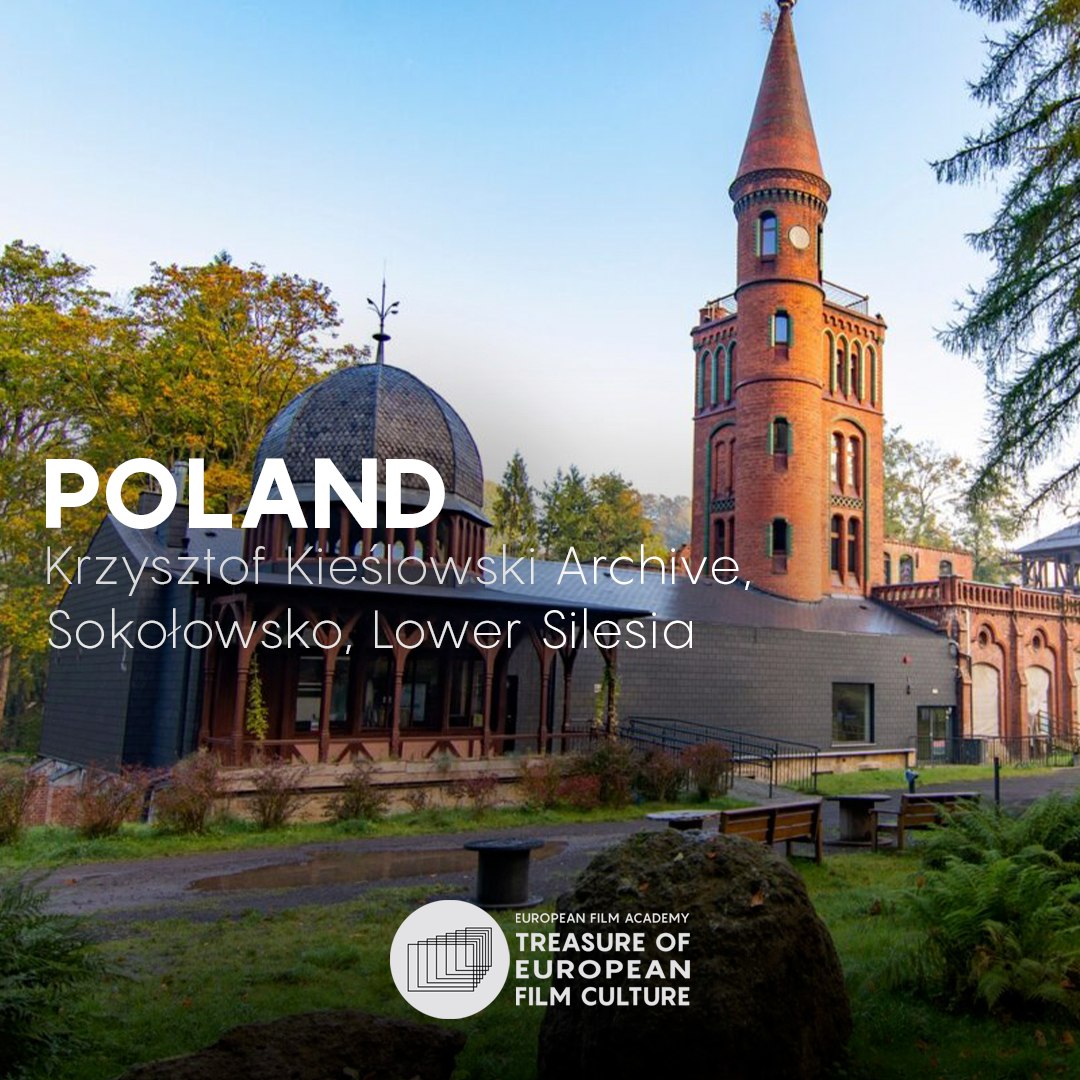
With this recognition, Sokołowsko joins an exceptional group of locations that have left a lasting mark on film history – alongside icons such as Plaza de España in Seville and the Bergman Center on the island of Fårö.
This distinction holds special meaning for us, as it is here, within the historic Kino Zdrowie, that the living memory of Krzysztof Kieślowski continues to resonate. Recognizing the Krzysztof Kieślowski Archive in Sokołowsko as a Treasure of European Film Culture is not only a symbolic gesture honoring the legacy of an outstanding filmmaker, but also an important step toward redefining how film heritage is preserved and shared across Europe. The initiative of the European Film Academy, developed since 2022, is part of a broader effort to safeguard both the tangible and intangible traces of cinema history as one of the foundations of European cultural identity. We invite you to visit the Archive’s entry as well as the whole Treasures of European Film Culture website.
In this context, Krzysztof Kieślowski occupies a unique place. His work – spanning documentary and feature films – transcends national boundaries, addressing universal ethical, existential, and metaphysical questions. Works such as “Dekalog,” “The Double Life of Véronique,” and the “Three Colours” trilogy have become enduring elements of the European film canon, while also prompting reflection on the condition of contemporary humanity. The archive of his work is therefore not merely a collection of artifacts, but a space for dialogue between past and present, between the individual experience of the artist and collective cultural memory.
Sokołowsko – the location of the archive – takes on symbolic significance in this light. This small town, thanks to the work of the In Situ Foundation and the Hommage à Kieślowski festival it organizes, has evolved into an important point on the map of European film events. The archive, closely linked to the historic Kino Zdrowie building, exemplifies how a local space can be integrated into the international circulation of culture. In doing so, it embodies the idea of decentralizing heritage — shifting attention from major metropolises to peripheral places that gain new meaning through their connection to outstanding artists.
Each site on this prestigious list serves as a carrier of film memory – a space where the history of cinema becomes tangible and accessible. What unites them is their ability to combine aesthetic, historical, and educational value. The Kieślowski Archive fits perfectly within this framework, offering both access to primary sources (scripts, notes, production materials) and opportunities to participate in artistic and educational events.
It is also significant that this is the third location in Poland to receive this title — alongside Księży Młyn, associated with “The Promised Land” by Andrzej Wajda, and the Inflancka housing estate in Warsaw, known from “Dekalog.” This recognition reflects the growing appreciation of Poland’s contribution to European cinema and highlights the need for a systemic approach to preserving its heritage. Through such initiatives, Poland is becoming an important participant in the international network of institutions dedicated to archiving and promoting film culture.
The unveiling ceremony of the Treasure of European Film Culture plaque will take place during the 15th anniversary edition of the Hommage à Kieślowski festival in 2026. This act will symbolically affirm the archive’s status as a site of memory, while also emphasizing its role as a living, dynamic space – open to contemporary interpretations and new forms of cultural participation.