![[:pl]Hommage à Kieślowski — Festiwal filmowy w Sokołowsku[:en]Hommage à Kieślowski — Film Festival in Sokołowsko[:cs]Hommage à Kieślowski — Filmový festival / Sokołowsko[:]](https://hommageakieslowski.pl/wp-content/themes/soko/img/hommage_head.svg)


Menu
2026
Diana Dąbrowska: “Human at the Threshold.” (Człowiek na granicy)
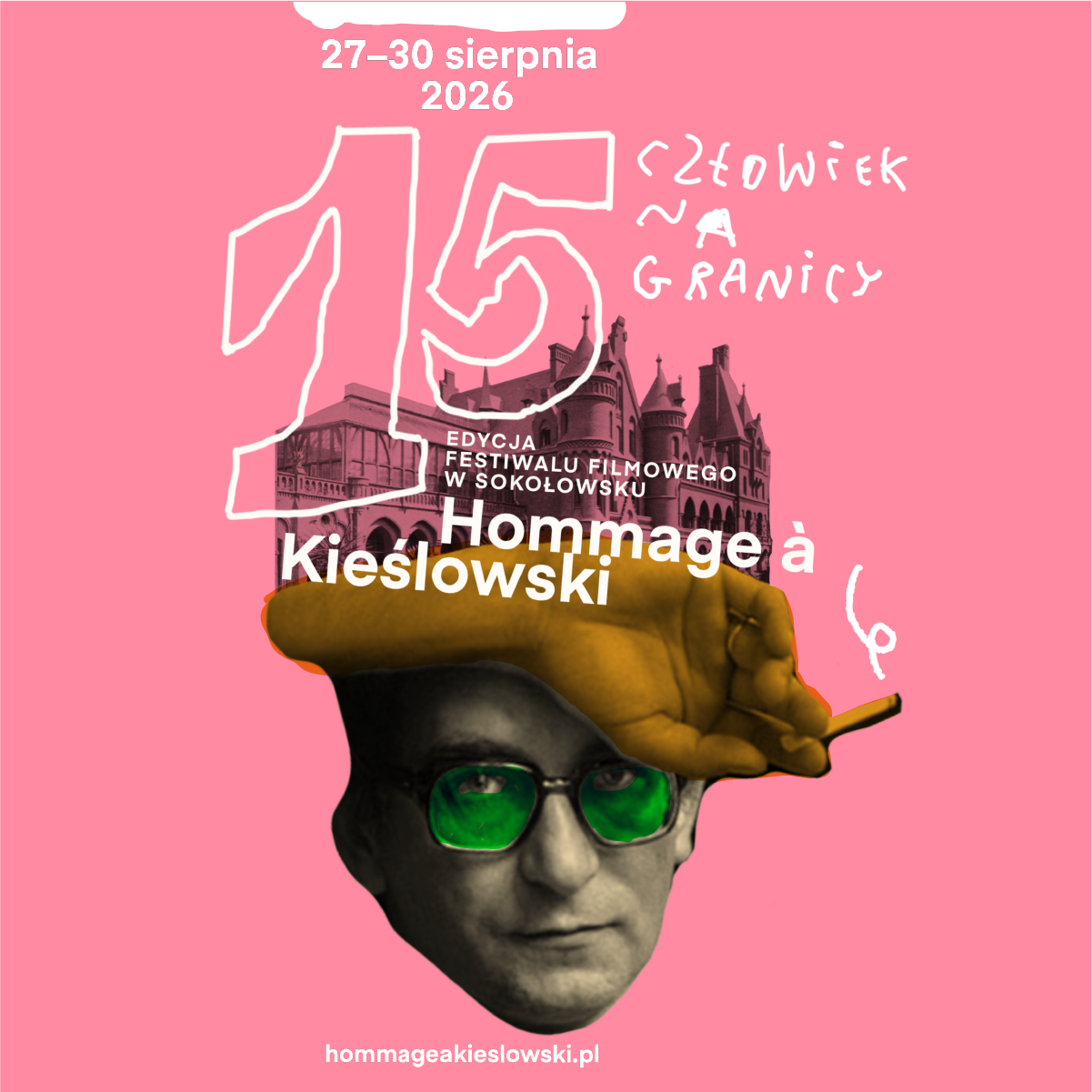
This year’s edition of our film and educational project carries a special significance. Fifteen years of festival activity coincides with the thirtieth anniversary of the death of Krzysztof Kieślowski, the patron of Hommage and one of the most important figures in Polish and European film culture, who passed away on 13 March 1996. Over the years we have tried to approach his work from many perspectives: by speaking with people who knew him personally, worked with him, and were his friends; by inviting scholars of Polish and international cinema; and finally by placing his films in dialogue with other works of European and world cinema, in order to show that Kieślowski belongs not only to history but remains a living partner in the contemporary conversation about the human being — the contemporary human being.
From the very beginning it was important for us not to view the author of The Double Life of Véronique as a monolith. On the contrary, we wanted to reveal the continuity of themes, intuitions and forms across the different stages of his work: between documentary and fiction, between Poland and France, between the precise observation of reality and an intuition of the invisible. For us, Kieślowski is not only an outstanding director and screenwriter but also a symbol of attentiveness toward another human being, sensitivity to the fragility of existence, and readiness for dialogue. His cinema does not provide easy answers; it does not organise the world according to simple moral judgments. On the contrary — it teaches us to look where certainty ends and ambiguity, suspension and inner fracture begin. It is precisely in this space that Kieślowski seems particularly necessary today. The Polish director never wanted to impose answers on his audience; instead, he posed questions. In numerous interviews he emphasised that he did not wish to judge his characters, because we usually see the consequences of their actions without knowing all the causes behind their behaviour and life choices.
For us, Sokołowsko remains not only a place of remembrance but also a place for continuing to read and reinterpret Kieślowski. The Krzysztof Kieślowski Archive, developed over many years by the In Situ Foundation, thanks largely to materials donated from the director’s family archive, aims to become a living centre for research, digitisation, residencies and artistic activity. It is therefore not merely a repository of the past but a workshop for new interpretations. This is also visible in projects currently being developed around Kieślowski’s legacy. In 2026 the premiere of a short film by the Quay Brothers is planned. This cinematic tribute to the director has been described by the project’s partners as a poetic journey through the images, ideas and intuitions that shaped his artistic world. Based on an unrealised script idea from his student years in Łódź, an animated film titled The Deer is currently being produced at the Wrocław Feature Film Studio, led by Robert Banasiak, directed by Izumi Yoshida.
Each year we try to identify a single idea that structures the festival programme. This time it is the theme “Human at the Threshold.” We understand it broadly — as an existential, social, political, geographical or spiritual experience. Today we live not so much beside borders as in a constant state of being on the threshold: between safety and fear, the real and the virtual, work and exhaustion, community and isolation. Anthropology calls such an experience liminality — a threshold state in which the old order no longer holds, while the new one has not yet taken shape. Victor Turner described such moments as spaces that open the possibility for new relationships, new forms of community and new ways of understanding ourselves. The jubilee fifteenth edition of Hommage à Kieślowski is for us precisely such a transitional moment: a chance to look back and at the same time an attempt to grasp what is yet to come.
This is why the concept of “metaxy” (Greek: μεταξύ), invoked by the Polish Nobel Prize laureate Olga Tokarczuk, is also so important to us. As the author of The Empusium explains in her lectures, metaxy — the “in-between” — does not mean emptiness, but a real and tangible space connecting opposites. This intuition perfectly describes Kieślowski’s cinema as well. His films unfold precisely in this realm “in-between”: between testimony and creation, between realism and metaphysics, between moral judgement and its suspension. What interested Kieślowski most was the moment when a person is not yet ready for a final definition — standing between guilt and innocence, loyalty and betrayal, hope and resignation, decision and its consequences.
We are therefore interested in the human being between orders — literally and metaphorically: between youth and old age, scream and silence, obedience and rebellion, home and exile, culture and nature. The protagonists of the films in this year’s edition find themselves precisely at such a moment: when everything may still happen, yet nothing remains as it once was. That is why, alongside the film (one of the revelations of the current film season) There Are No Ghosts in the Apartment on Dobra Street by Emi Buchwald, our programme also includes Sweet Rush by Andrzej Wajda, The Spindle of Time by Andrzej Kondratiuk, and Four Nights with Anna by Jerzy Skolimowski — works that in different ways tell the story of a human being on the threshold of transformation. Films and filmmakers in a constant creative dialogue — this is our mantra. We will gradually reveal the festival sections and individual titles in order to build suspense ahead of the approaching festival anniversary. One thing is certain: a lot will happen.
Returning to Kieślowski today, we do not wish merely to celebrate a great name or to enclose his work within the safe formula of a jubilee. Rather, we want to read his work anew — to grow into it again and again. We believe that every generation searches for some kind of light (echoing the famous line from the legendary Blind Chance), and Kieślowski’s cinema can remain one of the places where such a light still flickers: not as a ready answer, not as a clear signpost, but as a valuable point of reference. In a world that increasingly demands immediate judgments, simple divisions and quick reactions, Kieślowski’s work reminds us that the human being reveals themselves most fully not in moments of certainty but precisely on the threshold — where one does not yet know who one is, but where the question of meaning, responsibility and the presence of the other arises most intensely.
Diana Dąbrowska. Artistic Director of the 15th Edition of the Hommage à Kieślowski Festival.